
Dental Costs in Canada: What Insurance Covers, and How the CDCP Helps

Most Canadians pay for dental care one of three ways: a private or workplace plan, the Canadian Dental Care Plan (for households with adjusted family net income under $90,000 and no access to private coverage), or out of pocket. Whichever applies to you, asking for a written estimate before you book makes the cost predictable.
Cost is not a small worry. Statistics Canada found that about 35% of Canadians had no dental insurance in 2022, and nearly one in four avoided seeing a dental professional because of the cost, which is exactly the problem Orbit Dental’s up-front estimates exist to solve.
What does private dental insurance cover in Canada?
Most workplace and private dental plans sort treatment into three buckets (preventive, basic, and major) and pay a different share of each. Preventive care is usually covered most generously, major work least. Your real out-of-pocket cost then depends on two plan numbers: your annual maximum and your deductible.
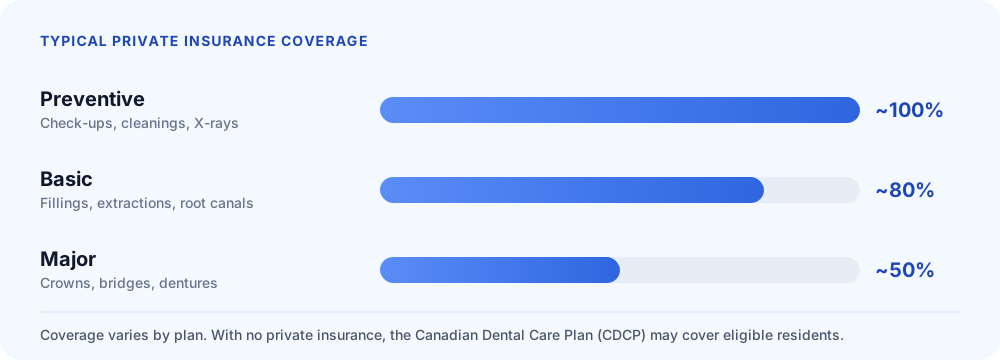
- Preventive care (check-ups, cleanings, routine X-rays) is typically the best-covered tier, often at or near full coverage, because it prevents expensive problems later.
- Basic care (fillings, extractions, root canals) is usually covered at a high but partial rate.
- Major care (crowns, bridges, dentures) generally has the lowest reimbursement and counts against your annual maximum.
Two numbers decide your real cost: your annual maximum (the cap your plan pays per year) and your deductible (the amount you pay before coverage kicks in). Check your plan booklet for both, they turn a scary invoice into simple arithmetic.
One more Ontario-specific wrinkle: the Ontario Dental Association publishes an annual Suggested Fee Guide, but dentists are not required to follow it, they set their own fees, which can sit above or below the Guide. That’s why the same filling can cost different amounts at different offices, and why an estimate matters.
Who qualifies for the Canadian Dental Care Plan (CDCP)?
According to the Government of Canada’s eligibility criteria, you may qualify for the CDCP if you meet all four requirements: no access to private dental insurance, you (and your spouse or partner) filed last year’s Canadian tax return, your adjusted family net income is under $90,000, and you’re a Canadian resident for tax purposes.
Two details catch people out:
- “Access” is strict. Having access to a private plan, even employer coverage you declined, pay a premium for, or never use, makes you ineligible. Check box 45 of your T4 or box 015 of your T4A before applying.
- Government social programs don’t disqualify you. If you have dental coverage through a provincial, territorial, or federal social program, you can still qualify, and the plans coordinate benefits.
Since mid-2025 there is no age restriction, the plan is open to eligible Canadians of all ages, and as of May 31, 2026, more than 6.5 million Canadians were approved under it.
How much does the CDCP actually pay?
The CDCP pays a percentage of its established fees based on your adjusted family net income. Families under $70,000 have no co-payment; between $70,000 and $89,999 you pay a share of each visit. You may also owe extra if your dentist’s fees exceed what the plan reimburses.
Here are the exact tiers from the official CDCP coverage page:
| Adjusted family net income | CDCP pays | Your co-payment |
|---|---|---|
| Under $70,000 | 100% of CDCP established fees | 0% |
| $70,000 – $79,999 | 60% | 40% |
| $80,000 – $89,999 | 40% | 60% |
Two caveats worth knowing before you sit in the chair:
- CDCP fees may differ from what a dental office charges. Even at the 0% co-pay tier, you can owe additional charges if your provider’s fee exceeds the CDCP reimbursement, so ask up front about anything the plan won’t cover.
- Coverage is broad but not unlimited. The plan covers exams, X-rays, cleanings (scaling), fillings, root canals, dentures, and extractions, with some services requiring preauthorization. Orthodontics is not yet covered, canada.ca lists it as coming “at a date to be determined.”
The payoff is real: Health Canada reports that CDCP members save an average of $900 per year on dental services.
Does every dentist accept the CDCP?
No. Provider participation in the CDCP is voluntary, so the Government of Canada advises confirming your provider accepts CDCP patients before booking. Nearly 29,000 oral health providers across Canada participated as of mid-2026, and participating offices bill Sun Life, the plan administrator, directly.
One rule matters more than any other: never pay the full bill yourself expecting reimbursement. Only providers get reimbursed under the CDCP, if you pay the full cost out of pocket, Sun Life will not pay you back. You should pay only your co-payment plus any agreed extra charges, directly to the office.
If you’re planning a first CDCP appointment, we’ve written a separate walkthrough of what a CDCP visit looks like at an Ontario dentist, from member card to direct billing.
How do you find out your cost before you book?
Ask for the estimate in advance, every path has one. Private plans can pre-determine coverage, CDCP providers can submit an estimate to Sun Life before treatment, and uninsured patients can request a written quote. Orbit Dental’s partner clinics run an out-of-pocket estimate against your coverage before you book, so you walk in knowing the number.
You can see how that works here. And if you currently have no coverage at all, you still have options, here’s how to see a dentist in Toronto without insurance without getting surprised by the bill.
One piece of guidance holds regardless of how you pay: the cheapest dental visit is the preventive one you actually attend. Skipping a well-covered cleaning to avoid a bill almost always costs more later, and if it’s been a while, our guide on getting back to the dentist after years away covers how to restart without judgment. For the bigger picture on choosing and booking care in the city, start with our complete guide to seeing a dentist in Toronto.
Frequently asked questions
How do I apply for the CDCP?
Apply online through My Service Canada Account, via Canada.ca, or by phone at 1-833-537-4342. You'll need your SIN, date of birth, address, and details of any government dental coverage, and you must have filed last year's tax return. Applications for the 2026–2027 benefit year are open.
Do I have to renew my CDCP coverage every year?
Yes. CDCP members must renew annually to confirm they still meet the eligibility requirements, and can renew as soon as they receive their latest CRA Notice of Assessment. Care received during a coverage gap is not covered or reimbursed, so renew before booking anything.
Does the CDCP cover braces or orthodontics?
Not yet. The official coverage page states a specific range of orthodontic services will be available in the future, "at a date to be determined." The plan currently covers exams, X-rays, cleanings, fillings, root canals, dentures, and extractions, with some services requiring preauthorization.
Can I get the CDCP if I turned down my employer's dental plan?
No. Having access to private dental insurance disqualifies you, even if you declined it, pay a premium for it, or never use it. The main exception is retirees who opted out of pension dental coverage before December 11, 2023 and cannot opt back in.