

For most healthy adults, a dental exam every six months is a sensible default, but it is a starting point, not a rule. The Canadian Dental Association says the right interval depends on your oral health needs: some people need more frequent visits, while others can safely go once a year.
Is it really necessary to go to the dentist every 6 months?
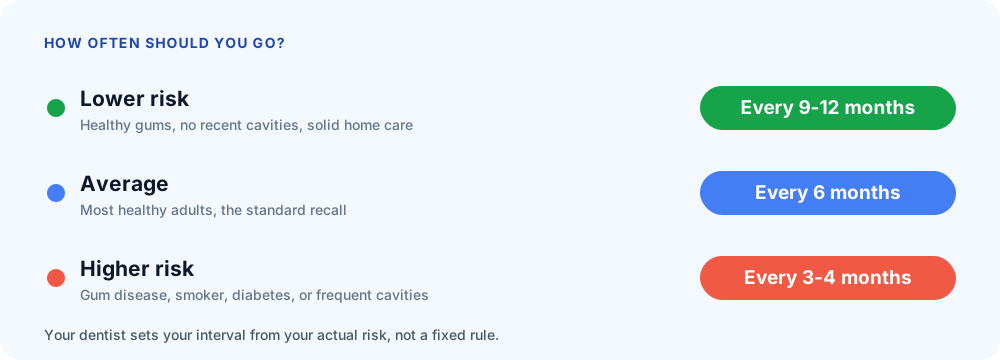
No single interval fits everyone. The Canadian Dental Association says exam frequency depends on your oral health needs, for many people that works out to a dental exam every six months, but some need more frequent visits and others can safely have a yearly exam.
The six-month habit is a rule of thumb, not a result of hard science. What the CDA does say is that the goal is to catch small problems early, and for many mouths, two exams a year happens to achieve that. For a stable, low-risk adult it may be more than necessary; for someone managing gum disease it is not nearly enough.
One more thing worth knowing: the CDA explicitly warns against letting your dental plan’s coverage decide how often you visit. Your interval should come from your dentist’s assessment of your mouth, not from what your insurance happens to reimburse.
What factors determine how often you should get a dental checkup?
Dentists set your recall interval from your risk of disease, not the calendar. The main factors are your gum health, your cavity history, how quickly tartar builds up on your teeth, medical conditions like diabetes or dry mouth, smoking, and how consistent your brushing and flossing are at home.
- Gum health. Active gum disease usually means more frequent cleanings until it is controlled. It is common: per Health Canada’s Canadian Health Measures Survey, 21% of Canadian adults with natural teeth have had a moderate or severe gum problem.
- Cavity history. The same survey found 96% of Canadian adults have a history of cavities. If yours are recent or frequent, more frequent checks catch new ones while they are still small.
- Tartar buildup. Some mouths mineralize plaque faster than others, the CDA lists this among the factors your dentist weighs.
- Medical factors. Diabetes, smoking, dry mouth, pregnancy, and some medications all raise risk.
- Home care. Consistent brushing and flossing genuinely stretches how long you can safely go.
The visit itself is not the goal. Catching problems while they are small and cheap is the goal, and your interval is just the tool for that. That risk-based approach is exactly how Orbit Dental’s partner clinics set recall intervals, from your mouth, not a one-size-fits-all schedule.
How often do you need dental X-rays?
Not at every visit. According to the Canadian Dental Association, a healthy adult who has not had cavities or other problems for a couple of years probably won’t need X-rays at every appointment, while someone whose dental situation is less stable may need them more often.
Like your recall interval, imaging is based on need. If your dentist is monitoring an active problem, expect X-rays more frequently; if your last several visits have been uneventful, expect fewer. If you are curious what the rest of the appointment involves, we walk through the whole thing in what to expect at a dental check-up.
What happens if you don’t go to the dentist regularly?
Small, cheap problems get time to become large, expensive ones. Early gum disease (gingivitis) is reversible, but left untreated it can break down the bone that holds your teeth in place. Statistics Canada reports more than one-third of Canadians had not seen a dental professional in the previous 12 months.
That reversibility window is the strongest argument for regular visits. The Canadian Dental Association notes that gum disease can be turned around in its early stages, but once the supporting bone breaks down, teeth can loosen and fall out. A recall exam also screens for things you cannot feel, including early signs of mouth or throat cancer.
Cost is the most common reason people stretch the interval: Statistics Canada found nearly one in four Canadians (24%) have avoided a dental professional because of cost. If it has been a while, you are in good company and it is fixable, here is how to get back to the dentist after years away.
Does insurance or the CDCP cover routine checkups?
Many private dental plans emphasize preventive care, and the Canadian Dental Care Plan covers dental exams, X-rays, and cleanings (scaling) for eligible members, subject to frequency limits and plan rules. Either way, your dentist, not your coverage, should set how often you actually come in.
Skipping a covered or low-cost preventive visit to save money usually backfires, because the small problem it would have caught becomes the expensive one later. We broke that math down in our guide to dental costs, insurance, and the CDCP.
So, how often should you go?
If you are healthy with good home care, every 6 to 12 months is reasonable. If you have any of the risk factors above, expect your dentist to suggest coming in more often, at least until things stabilize. The honest answer is that your dentist should tell you, and explain why.
Not sure where to start, or don’t have a regular dentist? Our complete guide to finding a dentist in Toronto covers how to choose, what visits cost, and what to expect. Booking through Orbit Dental shows your estimated cost up front and rewards you for completing your check-up, so the easy healthy habit stays easy.
Frequently asked questions
How often should you get your teeth cleaned?
There is no official fixed interval, the Canadian Dental Association advises seeing your dentist regularly for professional cleanings and exams, with the timing set by your dentist based on factors like how quickly tartar builds up on your teeth and the state of your gums.
Is going to the dentist once a year enough?
For some people, yes. The CDA notes that while some patients need frequent examinations, others with stable oral health can have a yearly exam. If you have a history of gum problems or recent cavities, once a year is probably too infrequent, ask your dentist to explain your interval.
How often should kids see the dentist?
The same risk-based logic applies, and children's risk is real: Health Canada's Canadian Health Measures Survey found 57% of children aged 6–11 have or have had a cavity. Regular exams let the dentist catch decay early and set an interval that fits your child's teeth and habits.
Should I still go if nothing hurts?
Yes. Per the Canadian Dental Association, a dental exam checks far more than pain, your gums, existing fillings and crowns, early cavities, and screening for signs of mouth or throat cancer, none of which reliably hurt in their early stages. Pain is a late signal, not an early one.